
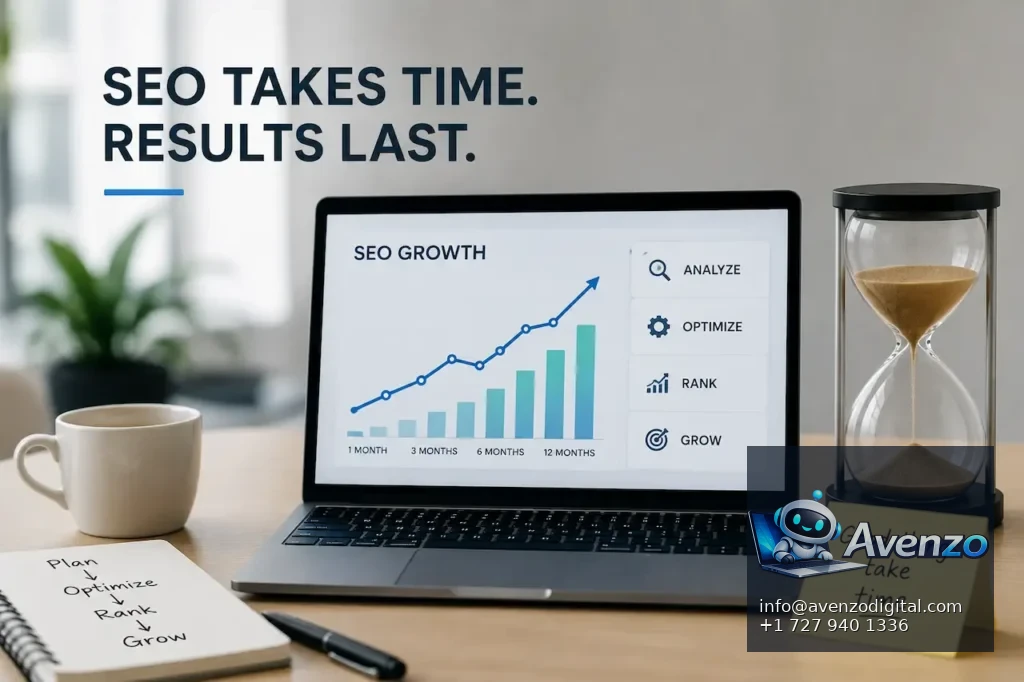
Launching a new business website is an important step, but getting it to appear prominently in search results usually takes time. Unlike paid advertising, where visibility can begin almost immediately after a campaign launches, SEO depends on search engines discovering your website, understanding its content, evaluating its quality, and gradually building confidence in its relevance and authority.
SEO for a new business website, it is normal to wonder how long SEO will take before results become visible. There is no universal timeline because SEO performance depends on factors such as competition, industry, location, website quality, technical setup, content depth, search intent, backlinks, and the keywords you are targeting. A local business targeting a specific city may see meaningful progress sooner than a national company competing for highly competitive search terms.
In many cases, a new website may begin showing early SEO signals within the first few months, while more meaningful organic growth can take several months of consistent work. Highly competitive markets can require significantly more time. The important point is that SEO should be viewed as an ongoing growth process rather than a one-time task that produces instant rankings.
Why Does SEO Take Time for a New Website?
Search engines need time to discover and evaluate a new website. A newly launched domain does not automatically have the same level of trust, authority, content depth, or historical signals as an established website that has been publishing useful information and earning relevant links for years.
The first stage is discovery. Search engines need to find your pages and crawl them. After that, they need to understand what those pages are about and determine which searches they may be relevant for. Ranking decisions involve many signals, and your website must compete with other pages that may already have stronger authority and established search visibility.
This is why publishing a website and expecting immediate rankings can lead to unrealistic expectations. SEO requires both technical accessibility and evidence that the website deserves visibility for the searches it is targeting.
A new website also needs time to establish a broader content footprint. If you have only a homepage and a few service pages, there may be limited opportunities to rank for different searches. As you publish useful, relevant content and build strong relationships between your pages, your website can develop greater topical coverage.
What Can a New Business Expect During the First Few Months?
The first few months of SEO are often focused more on building a strong foundation than achieving major traffic growth. During this stage, your team may work on technical SEO, keyword targeting, website structure, metadata, internal linking, content optimization, indexing, and other foundational improvements. Search Console and analytics data can also begin providing information about how search engines and users are interacting with the website.
You may see impressions before you see significant clicks. Some pages may begin appearing for long-tail searches or lower-competition keywords before they reach strong positions for more competitive terms. This early data is useful because it shows which pages and topics are gaining visibility. SEO strategies can then be adjusted based on actual performance rather than assumptions.
A new business should therefore avoid judging SEO entirely by whether the website has reached page one during the first few weeks. Early progress can include improved indexing, increased impressions, more keyword visibility, and the first organic visitors.
When Do New Websites Start Ranking on Google?
There is no guaranteed date when a new website will start ranking. Some pages can become visible relatively quickly for less competitive searches, while others may take much longer. Ranking also happens on a keyword-by-keyword and page-by-page basis. A new service page may begin ranking for a specific local search while remaining far from the first page for a broad industry term. This is why it is more useful to monitor groups of relevant keywords instead of expecting the entire website to suddenly start ranking.
For example, a new web development company might initially gain visibility for specific service searches, location-based queries, and long-tail questions. Over time, stronger pages may begin competing for broader terms as the website develops more content and authority.
The timeline depends heavily on the competitiveness of the search results and the strength of the pages you are competing against.
Does Competition Affect How Long SEO Takes?

Competition is one of the biggest factors affecting SEO timelines. If only a small number of businesses are targeting a particular search term, a well-optimized page may have an opportunity to gain visibility relatively quickly. If hundreds of established companies are competing for the same keyword, ranking can require significantly more authority, stronger content, better user experience, and sustained SEO work.
Consider the difference between a highly specific local search and a broad national keyword. A local business targeting a specific service in one city may be competing against a manageable group of businesses. A company trying to rank nationally for a broad commercial keyword may be competing against major brands and websites with years of SEO history.
This does not mean a new business should avoid competitive keywords. Instead, it should build a strategy that combines realistic opportunities with longer-term targets.
Why Should New Businesses Target Long-Tail Keywords?
Long-tail keywords are often more specific than broad keywords and can provide useful opportunities for new websites. For example, a broad keyword may describe an entire industry, while a long-tail search may describe a specific service, problem, audience, or location. These more specific searches often have a clearer intent.
A new website may have a better opportunity to gain visibility for specific searches before competing successfully for broad, highly competitive keywords.
Long-tail keywords can also attract more qualified visitors because the search itself provides additional context. Someone searching for a very specific service may be further along in the decision-making process than someone searching for a broad informational term. A balanced SEO strategy can therefore target a combination of long-tail opportunities and broader keywords that become more realistic as the website grows.
How Does Website Quality Affect SEO Results?
Website quality can influence how effectively your SEO strategy performs. Search engines need to be able to crawl your website, understand its pages, and determine whether those pages provide useful information for searchers. A technically sound website should have accessible pages, clear structure, descriptive titles, appropriate headings, useful content, logical internal links, and a good user experience.
Website quality also extends beyond technical elements. Your content should address real questions and problems that your target audience has. Service pages should clearly explain what you offer, who you help, and why someone should consider your business.
A new website with strong technical foundations and useful content has a better starting point than a website that is difficult to crawl or provides little value to visitors.
Does Website Speed Affect SEO Timelines?
Website performance is an important part of overall website quality. A slow website can create friction for visitors and make it harder for them to interact with important pages. Performance is particularly important on mobile devices, where users may have different network conditions and less powerful hardware.
Improving speed does not automatically make a new website rank at the top of Google, but performance should be part of a broader technical SEO strategy. A website should load efficiently, provide a stable experience, and allow users to access important content without unnecessary delays. Businesses that need to improve performance can also consider website speed optimization as part of their broader website strategy.
How Important Is Technical SEO for a New Website?

Technical SEO provides the foundation that allows search engines to access and understand your website.
Before investing heavily in content or link building, make sure important technical elements are working correctly. This includes crawlability, indexing, XML sitemaps, canonical URLs, redirects, mobile usability, site architecture, and other technical considerations.
Technical problems can prevent valuable pages from being indexed or create unnecessary confusion for search engines.
For example, a page that is blocked from crawling or incorrectly marked as noindex may not appear in search results regardless of how much effort goes into optimizing its content. Technical SEO therefore should be addressed early rather than waiting until after ranking problems appear.
How Does Content Affect SEO Growth?
Content gives search engines more opportunities to understand your expertise and match your website with relevant searches. A new business website often begins with a limited number of pages. Adding useful service pages, location pages where appropriate, educational articles, FAQs, case studies, and other relevant resources can expand the website’s ability to address customer questions.
However, publishing large amounts of low-quality content simply to increase page count is not an effective strategy. Each page should have a clear purpose and provide useful information for a specific audience or search intent.
A smaller website with genuinely useful content can be more valuable than a large website filled with repetitive or shallow pages. The goal should be to build topical depth over time rather than publishing content simply to meet a numerical target.
How Often Should a New Business Publish Content?

There is no universal publishing frequency that guarantees SEO results. The right schedule depends on your resources, industry, competition, and content strategy. Consistency is generally more useful than publishing a large number of articles at once and then stopping for several months.
A new business might create a realistic content calendar based on important customer questions, commercial services, and keyword opportunities. Each article can support the broader website by answering a specific question and linking naturally to relevant service pages.
Over time, this creates a connected content ecosystem rather than a collection of unrelated blog posts. The quality and relevance of the content should remain more important than publishing frequency.
How Does Internal Linking Help a New Website?
Internal links connect pages within your website and help visitors move between related topics. They can also help search engines discover pages and understand how different parts of your website relate to one another.
For example, a blog about website redesign could link naturally to a relevant website redesign service. An article about improving Shopify performance could connect to Shopify speed optimization.
This creates a clearer relationship between informational content and commercial pages. Internal linking can also help distribute authority between pages and make important pages easier to discover. For a new website, developing a logical internal linking structure early can make the site easier to navigate as more content is added.
Do Backlinks Matter for a New Business Website?
Backlinks can be an important part of SEO because links from other relevant websites can help establish authority and credibility. However, acquiring large numbers of low-quality links is not a sustainable strategy. The focus should be on earning relevant and trustworthy links that make sense for your business. A new business may have few external links at launch, which means it may be competing against websites with much stronger link profiles.
Building authority takes time. Businesses can work toward earning links through useful content, partnerships, industry resources, digital PR, local relationships, case studies, and other legitimate methods. The quality and relevance of the links matter more than simply trying to accumulate the largest possible number.
How Does Local SEO Change the Timeline?
Local SEO can sometimes provide more focused opportunities for a new business because the competitive environment is geographically limited. A business serving one city does not necessarily need to compete against every website in the country. It can focus on searches related to its services and specific service area.
A strong local SEO foundation can include accurate business information, location-focused pages where appropriate, a properly optimized Google Business Profile, customer reviews, local citations, relevant content, and consistent local signals.
The timeline still varies based on competition and market conditions, but a focused local strategy can be more achievable than immediately targeting broad national keywords.
Should a New Business Focus on Local or National Keywords?
The answer depends on how the business serves customers. If you operate in a specific geographic area, local keywords may provide a more realistic starting point. A business serving multiple regions may need a broader strategy, while an online company may compete nationally or internationally.
Local searches can also have strong commercial intent. Someone searching for a specific service in their city may already be looking for a provider.
A new business should therefore align its keyword strategy with its actual service area and customer acquisition model rather than targeting broad keywords simply because they have high search volume.
How Long Does It Take to Get Organic Traffic?
Organic traffic can begin appearing relatively early, but meaningful traffic growth usually requires consistent SEO work. Early traffic may come from branded searches, long-tail queries, lower-competition keywords, or pages that quickly gain visibility. As the website builds stronger content and authority, more keywords may begin generating impressions and clicks.
Traffic growth is rarely perfectly linear. You may experience periods of rapid improvement followed by slower periods as the website competes for more difficult keywords.
It is also important to focus on traffic quality rather than traffic volume alone. One highly relevant visitor who becomes a customer may be more valuable than dozens of visitors who have no interest in your services.
How Long Does It Take to Reach Page One?
Page-one rankings can take different amounts of time depending on the keyword. A low-competition long-tail keyword may reach page one relatively quickly if the page closely satisfies the search intent and the website has a strong foundation. A highly competitive commercial keyword may take much longer and require significant authority. This is why SEO reports should track ranking progress across a range of keywords.
Instead of asking only whether one major keyword has reached page one, look at how many relevant keywords are gaining visibility, whether average positions are improving, whether impressions are increasing, and whether organic conversions are growing. This provides a much more accurate picture of SEO progress.
Why Does SEO Sometimes Take Longer Than Expected?
Several factors can slow SEO progress. A highly competitive industry, weak content, technical problems, poor website architecture, limited backlinks, unrealistic keyword targets, inconsistent publishing, and insufficient optimization can all contribute. Another issue is targeting keywords that are too difficult for the website’s current authority level.
For example, a new website may immediately target a keyword dominated by major national brands. Even excellent content may struggle to compete against websites with years of authority and thousands of relevant links.
A more strategic approach is to build momentum with achievable opportunities while gradually working toward more competitive targets.
What Should You Track During the First Six Months?
Rankings are important, but they should not be the only metric you monitor. A new business should look at several indicators to understand whether SEO is moving in the right direction. These can include:
- Organic impressions
- Organic clicks
- Keyword visibility
- Average ranking positions
- Indexed pages
- Organic engagement
- Leads or inquiries
- Organic conversions
- Relevant referring domains
Search Console can be particularly useful for identifying which queries are generating impressions and clicks. Analytics can then help you understand what visitors do after arriving on the website. These metrics provide context and help identify opportunities for improvement.
What Should a New Business Do During the First Three Months?

The first three months should focus heavily on establishing a strong foundation. Start by making sure search engines can crawl and index the website properly. Review the site’s structure, metadata, internal links, sitemap, redirects, canonical tags, mobile experience, and other technical elements.
Then review your keyword strategy and make sure important commercial pages target relevant search intent. Service pages should provide enough information to be useful while clearly communicating what the business offers.
You can then begin developing supporting content around important customer questions and long-tail searches. This stage is about creating a website that is ready to compete rather than expecting immediate large-scale traffic.
What Should You Focus on Between Three and Six Months?
Once the technical foundation is stable, the focus can shift toward expanding content, strengthening internal linking, improving existing pages, and building authority.
Look at the keywords where your pages are already receiving impressions but are not yet ranking strongly. These can provide opportunities for content improvements.
You can also identify pages that receive organic traffic but have weak conversion performance. Improving calls to action, page structure, messaging, and user experience can help turn existing visibility into more valuable business outcomes. At this stage, SEO should become increasingly data-driven. Use actual search and website performance data to determine where your next efforts should go.
What About SEO After Six Months?
SEO should not stop after six months. In many cases, this is when a website has enough data to make more informed strategic decisions. You can identify which topics are producing results, which services are generating organic leads, which keywords remain difficult, and where additional content or authority may be needed.
Existing content should also be reviewed periodically. Search intent can change, competitors can publish stronger pages, and your business may introduce new services. Continued optimization helps protect existing visibility while creating opportunities for further growth.
Can You Speed Up SEO Results?
You cannot guarantee a specific SEO timeline, but you can avoid unnecessary delays by building the right foundation from the beginning. Make sure the website is technically accessible, target realistic keywords, publish genuinely useful content, create logical internal links, improve important pages, build relevant authority, and monitor performance consistently.
Avoid shortcuts that promise instant rankings. Aggressive tactics or low-quality link building can create problems rather than sustainable growth. The most effective way to accelerate SEO is usually to reduce wasted effort and focus resources on activities that have a clear relationship with your target audience and search intent.
Should You Invest in SEO Before Launching a Website?
Ideally, SEO considerations should begin before the website launches.
The website structure, URL system, page hierarchy, content strategy, keyword targeting, internal linking, and technical setup can all be planned before launch. This is much easier than launching a website with one structure and then rebuilding it after discovering that important pages, keywords, or navigation paths were overlooked.
A website pre-launch checklist can help businesses review important areas before making a new website publicly available. Planning SEO early can also reduce the risk of unnecessary URL changes, missing content, technical issues, and migration problems.
What If Your New Website Is Not Getting Traffic?
If a new website is receiving little or no organic traffic, do not immediately assume that SEO is failing.
First, check whether the pages are actually indexed. Then review technical accessibility, keyword targeting, content quality, competition, and search intent.
You should also confirm that the website is targeting searches that people actually use. A page can be perfectly optimized for a keyword that receives very little search demand.
Review Search Console for impressions and queries. If pages are receiving impressions but few clicks, titles and descriptions may need improvement. If pages have no impressions at all, the issue may be related to indexing, relevance, competition, or content coverage.
SEO diagnosis should be based on evidence rather than assumptions.
Does a Website Redesign Reset SEO?
A redesign does not automatically reset SEO, but changes to URLs, content, internal links, navigation, metadata, and technical settings can affect existing search visibility.
This is especially important for an established business website with existing rankings and backlinks. A redesign should preserve important SEO signals wherever possible and include appropriate redirects when URLs change.
For a new business website, the issue is different because there may not be much existing authority to preserve. However, planning the website correctly from the beginning can still prevent future SEO problems.
Businesses considering a redesign can review their website redesign requirements with SEO in mind rather than treating search optimization as something to address after launch.
Final Thoughts
So, how long does SEO take for a new business website? There is no single timeline that applies to every business. A new website may begin generating early impressions and rankings within the first few months, while stronger organic visibility and meaningful traffic growth can take several more months. Competitive industries and difficult keywords may require an even longer-term strategy.
The most important factor is not simply waiting for Google to rank your website. It is consistently improving the factors that give your website a better opportunity to rank. Technical SEO, useful content, relevant keywords, internal linking, website performance, authority, and user experience all contribute to the process.
New businesses should focus on building a strong foundation first, then use real performance data to guide ongoing improvements. Start with realistic keyword opportunities, create pages that genuinely satisfy search intent, strengthen your website structure, and gradually build authority.
It is also important to measure progress beyond rankings. Growing impressions, increasing keyword visibility, improved organic clicks, stronger engagement, and qualified leads can all indicate that your SEO strategy is moving in the right direction.
SEO is not a switch that suddenly turns traffic on. It is a process of building visibility and trust over time. Businesses that approach it with realistic expectations and consistent effort are better positioned to develop sustainable organic growth.
For a new business website, the goal should not be to ask, “How quickly can I rank?” A better question is, “What can I consistently improve so my website becomes more useful, relevant, and competitive?”
That mindset creates a stronger long-term SEO strategy and gives your website a better chance of turning search visibility into real business results.
Frequently Asked Questions
1. How long does SEO take for a new business website?
SEO for a new business website may start showing early SEO signals within the first few months, but meaningful organic growth often takes several months of consistent optimization and content development.
2. Can a new website rank on Google quickly?
Yes, especially for specific, low-competition, or long-tail keywords. Competitive keywords usually require more time, content, and authority.
3. Why does SEO take so long for a new website?
Search engines need time to discover, crawl, understand, and evaluate a new website. Building content, authority, and trust also takes time.
4. Does website competition affect SEO results?
Yes. Websites competing in highly competitive industries may need significantly more time and resources to achieve strong rankings.
5. Should a new business target long-tail keywords?
Yes. Specific long-tail keywords can provide more realistic ranking opportunities for newer websites and may attract highly relevant visitors.
6. How important is technical SEO for a new website?
Technical SEO is essential because search engines need to crawl and index your pages properly. Issues with indexing, redirects, site structure, or accessibility can delay SEO progress.
7. Can local SEO help a new business rank faster?
Local SEO can provide more focused opportunities, especially when a business serves a specific city or geographic area. Competition and market conditions still affect the timeline.
8. What should I track during the first few months of SEO?
Monitor organic impressions, clicks, keyword rankings, indexed pages, website engagement, and organic leads or conversions to understand whether your SEO strategy is progressing.
9. Can I speed up SEO results?
You cannot guarantee a specific timeline, but you can avoid unnecessary delays by targeting realistic keywords, fixing technical issues, publishing useful content, building relevant authority, and consistently improving your website.
Related Avenzo Service
For a broader search strategy, explore Avenzo’s SEO services covering technical SEO, page architecture, internal linking, content, migrations, and measurement.
SEO Services →