
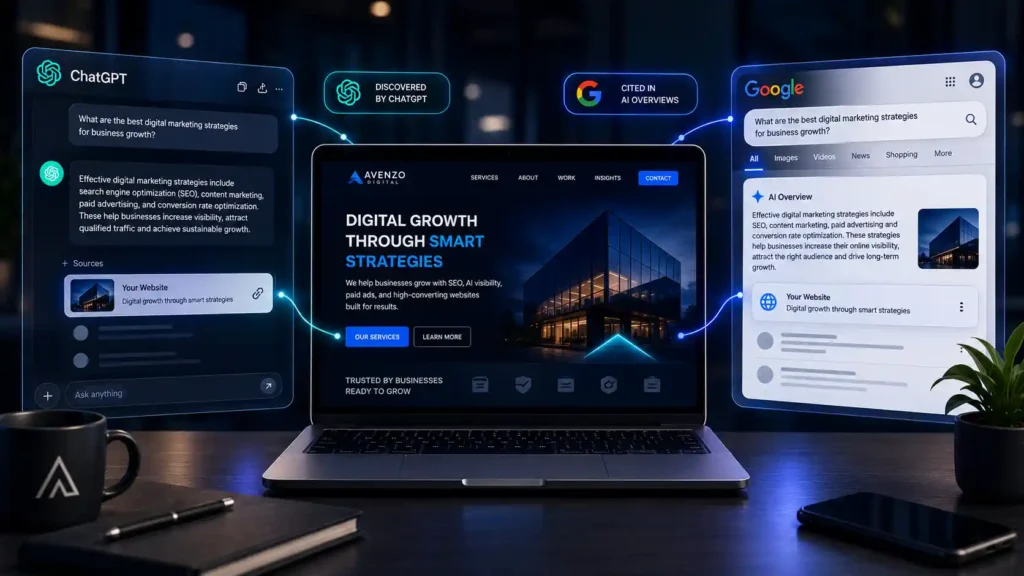

The way customers search for businesses is changing. Instead of only typing a few words into Google and opening several websites, people increasingly ask detailed questions in tools such as ChatGPT and Google’s AI-powered search experiences. These platforms can summarize information, compare options, answer follow-up questions, and link users to websites that support their responses.
For businesses, this creates a new visibility challenge. Ranking in traditional search results still matters, but businesses also want to know how they can appear in ChatGPT and Google AI Overviews when potential customers ask questions related to their services, products, industries, or locations.
There is no guaranteed submission method or special piece of code that automatically places a business inside an AI-generated answer. Google states that the same foundational SEO practices used for traditional Search remain relevant for AI Overviews and AI Mode, while OpenAI explains that websites can appear in ChatGPT search when their content is publicly accessible and available to its search crawler.
A well-planned Generative Search Optimization strategy focuses on making your website technically accessible, easy to understand, trustworthy, relevant to specific questions, and useful enough to be referenced when AI systems generate answers.
What Does It Mean to Appear in ChatGPT and Google AI Overviews?
Appearing in AI search does not always look like a traditional Google ranking. In normal search results, your website may appear as a blue link with a title and description. Generative search experiences can work differently. Your business or website may appear as a cited source supporting an AI-generated answer, a clickable link beside an AI response, a recommendation within a list of relevant businesses, a source used to explain a product or service, or a website referenced during a comparison.
This means businesses need to think beyond simply ranking for one keyword if they want to appear in ChatGPT and Google AI Overviews. The objective is to become a useful, trustworthy source that search and AI systems can retrieve when answering questions related to your expertise.
Can Any Website Appear in ChatGPT Search?
Public websites can potentially appear in ChatGPT search. OpenAI states that websites should allow OAI-SearchBot to access their content if they want their pages to be discoverable and available for summaries, snippets, citations, and links in ChatGPT search. OpenAI also notes that ranking is influenced by multiple factors and that top placement cannot be guaranteed.
If your website blocks the crawler responsible for ChatGPT search, your content may have fewer opportunities to be discovered directly for search experiences. Your robots.txt file, firewall, hosting environment, security configuration, and CDN should therefore be reviewed carefully.
A professional SEO audit can help identify whether technical restrictions are preventing search engines or AI search crawlers from accessing important pages.
How Do Websites Become Eligible for Google AI Overviews?
Google takes a slightly different approach because AI Overviews and AI Mode are integrated into Google Search, which affects how businesses can appear in ChatGPT and Google AI Overviews. According to Google, a page must already be indexed and eligible to appear in Google Search with a snippet before it can be considered as a supporting link within AI features.
Google specifically states that there are no additional technical requirements for appearing in AI Overviews or AI Mode beyond its normal Search requirements. This means businesses should not abandon traditional SEO in favor of a completely separate AI strategy.
Strong SEO services remain an important foundation because crawlability, indexing, content quality, internal linking, page experience, and relevance continue to influence whether Google can discover and understand your website.
Is Generative Search Optimization Different From Traditional SEO?
Generative Search Optimization and traditional SEO are closely connected, but they differ in how businesses approach visibility. Traditional SEO often focuses on ranking individual pages for specific search queries, while generative search handles more complex questions. For example, users may ask which local commercial roofing companies specialize in flat roof replacement or what to consider when redesigning an outdated service business website.
Google explains that AI Overviews and AI Mode can use query fan-out, issuing multiple related searches across different subtopics and sources to build a response.
As a result, your website can become relevant even without matching the exact wording of a user’s question, helping your business appear in ChatGPT and Google AI Overviews. Effective generative search optimization focuses on topical depth, clear entities, supporting information, authority, technical accessibility, and providing direct answers to the questions customers actually ask.
Start With Strong Technical SEO
AI visibility cannot compensate for a website that search systems struggle to crawl or understand. Before creating large amounts of AI-focused content, businesses should make sure the technical foundation of the website is working correctly.
Important areas include:
- Crawl accessibility
- Indexability
- Robots.txt configuration
- Canonical tags
- XML sitemaps
- Internal links
- HTTP status codes
- Mobile usability
- Website speed
- Structured data accuracy
- JavaScript accessibility
- Clear page architecture
Google specifically recommends allowing crawling, making content easy to discover through internal links, maintaining a strong page experience, and ensuring important information is available in textual form. If important service pages are blocked, orphaned, incorrectly canonicalized, or difficult to crawl, improving content alone may not solve the problem.
Make Sure OAI-SearchBot Can Access Your Website
Businesses interested in ChatGPT visibility should review whether OAI-SearchBot is allowed to access their public website. This crawler is associated with ChatGPT search discovery. OpenAI recommends ensuring that OAI-SearchBot is not blocked and that hosting or CDN infrastructure permits traffic from OpenAI’s published crawler IP addresses. This is different from assuming every AI crawler serves the same purpose.
Crawler controls should therefore be implemented carefully rather than copying generic robots.txt recommendations from another website. Businesses should understand which crawlers they want to allow, which content they want publicly accessible, and which pages should remain restricted. A simple technical configuration mistake can reduce discoverability even when the content itself is strong.
Create Content Around Real Customer Questions
Generative search systems are designed to answer questions. That makes customer questions extremely valuable when planning content. Businesses should identify the questions potential customers ask during different stages of the buying journey.
For example, instead of only creating a page targeting “commercial website development,” a business might also develop resources around how much a commercial website costs, how long website development takes, when an old website should be redesigned, what a service business website should include, why a website is generating traffic but not leads, and how website speed can affect conversions.
These questions provide additional context around the main service. The goal is not to create hundreds of thin pages for every possible question. Instead, build comprehensive resources around genuine customer problems.
Answer Important Questions Clearly
Content written for AI search should still be written for humans. Complicated language does not automatically demonstrate expertise. Clear explanations often make information easier for both visitors and retrieval systems to understand. When answering an important question, provide the direct answer first and then expand with supporting details.
For example, if the question is “Does a faster website improve conversions?” a useful section should clearly answer the question before explaining performance, user experience, Core Web Vitals, abandonment, and conversion behavior. Pages that repeatedly avoid answering the actual question may be less useful regardless of how many keywords they contain.
Build Topical Authority Instead of Publishing Random Articles
One isolated article rarely establishes deep expertise. Businesses should develop connected groups of content around their core services and industries. For example, a web development agency might create content covering responsive design, website redesign, WordPress development, website performance, website security, e-commerce development, conversion optimization, website maintenance, lead generation, and technical SEO.

These topics reinforce one another. Internal links can then connect informational articles to commercial pages such as website design services, SEO services, development pages, and relevant supporting resources.
This helps users move through the website while making relationships between topics easier to understand. Google specifically identifies internal linking and easily discoverable content as important practices for its AI-powered Search features.
Make Your Business Entity Easy to Understand
AI systems need context, not just keywords. Your website should clearly communicate your business name, services, industries, locations, expertise, qualifications, contact details, and relationships between services.
Keep this information consistent across important pages and trusted external profiles. Conflicting descriptions can make your business entity harder for AI systems to understand. Strong generative search optimization reduces this ambiguity.
Demonstrate First-Hand Experience
Generic content is easy to reproduce, making original experience more valuable. Businesses should include case studies, project examples, results, implementation processes, expert insights, customer outcomes, original images, and lessons from completed work.
Google emphasizes valuable, unique content rather than tactics designed specifically to manipulate AI systems. When many websites provide the same information, first-hand experience helps your content stand out and provides stronger evidence of expertise.
Strengthen E-E-A-T Signals
Experience, Expertise, Authoritativeness, and Trustworthiness remain useful principles when evaluating content quality. Businesses should make it easy for visitors to understand who created the content and why they should trust it.
Useful trust signals include accurate author information, professional team pages, case studies, real customer reviews, transparent business information, relevant qualifications, clear editorial standards, sources for factual claims, updated content, secure website infrastructure, and detailed service information. E-E-A-T should not be treated as a checklist where adding an author box automatically improves AI visibility. The objective is to demonstrate legitimate expertise throughout the website.
Create Strong Service Pages
Informational articles matter, but businesses also need strong commercial pages. A service page should clearly explain the service, who it serves, problems it solves, what is included, the process, expertise, service areas, FAQs, proof of work, and next steps.
Informational content should naturally link to relevant service pages, connecting what your business knows with what it sells.
Use Structured Data Correctly
Structured data can help search engines understand website information, but there is no special schema required for AI Overviews or AI Mode.
Relevant markup can still support traditional Search features. The key is accuracy: structured data should always match information visible on the page.
Do You Need an llms.txt File to Appear in AI Search?
Not as a requirement for Google AI Overviews. Google specifically states that website owners do not need to create new AI text files or special machine-readable files to appear in its generative Search features.
An llms.txt file may be experimented with by some website owners, but it should not replace fundamental SEO work. Crawlability, indexing, useful content, internal linking, entity clarity, authority, and accessibility remain much more important.
Improve Internal Linking
Internal links help users and search systems discover related content. Blog posts should naturally link to relevant services and supporting articles, such as Generative Search Optimization services.
Every link should provide value and guide visitors toward a logical next step. A strong structure also helps prevent orphan pages.
Build External Authority
Your website is only one source of information about your business. AI-powered search may also use directories, publications, reviews, industry resources, and other websites.
Build authority through relevant mentions, quality backlinks, digital PR, expert contributions, reviews, professional profiles, partnerships, and original research. Focus on quality and relevance rather than large numbers of low-quality links.
Keep Information Consistent Across the Web
Business information should remain consistent across major platforms, including company name, location, website, phone number, and services.
This is especially important for local businesses. Accurate location and service-area information can help search systems provide more relevant results for location-based queries.
Optimize for Specific Topics Instead of Mentioning Everything
Avoid making every page relevant to every service. Each page should have a clear primary topic. A responsive web design page should focus on responsive design, while a technical SEO page should focus on technical SEO.
Related services can be mentioned when relevant, but unrelated topics can weaken topical clarity. Clear topical focus helps generative search systems find precise information for precise questions.
Use Descriptive Headings
Headings make long content easier to understand. They should explain what each section actually answers. Weak headings such as “More Information” provide very little context. Specific headings such as “How Does Technical SEO Affect AI Search Visibility?” immediately communicate the subject. A logical heading hierarchy also improves readability for visitors scanning a long article.
Keep Important Information in Text
Modern websites often use interactive designs, videos, graphics, animations, and other visual elements. These can improve user experience, but essential information should not exist only inside an image or difficult-to-access interactive element. Google specifically recommends making important content available in textual form for its AI Search features.
Important service details, product information, explanations, qualifications, and business information should therefore be accessible as normal website text. Images and videos can support that content rather than replacing it completely.
Important service details, product information, explanations, qualifications, and business information should therefore be accessible as normal website text to support efforts to appear in ChatGPT and Google AI Overviews.
Website Performance Still Matters
Generative search does not eliminate the importance of user experience when businesses want to appear in ChatGPT and Google AI Overviews. Someone who clicks a source from an AI response still lands on a website. If that website is slow, confusing, difficult to use on mobile, or filled with disruptive elements, the visibility provides little business value.
Improving website speed and page experience helps businesses turn search visibility into actual engagement. Google also continues to recommend good page experience as part of its guidance for websites seeking visibility within generative Search features.
AI Visibility Should Lead to Business Results
Being mentioned by ChatGPT or displayed within an AI Overview can be valuable when businesses want to appear in ChatGPT and Google AI Overviews, but visibility alone is not the final objective. Businesses should evaluate what happens afterward. Do visitors visit the website, read additional pages, request consultations, submit forms, purchase products, call the business, become qualified leads, or return later through another channel?
Generative search should ultimately support business outcomes. A website that earns AI citations but generates no relevant engagement may need stronger conversion paths or better alignment between informational content and commercial services.
How Can You Track Traffic From ChatGPT?
OpenAI states that publishers allowing OAI-SearchBot can track referral traffic from ChatGPT using analytics platforms such as Google Analytics. Businesses should monitor referral sources alongside landing-page performance. This can help identify which pages receive ChatGPT referrals, whether those visitors engage, which services attract interest, whether visitors convert, and which content topics appear to generate AI discovery.
Not every AI mention will produce a measurable website visit, so referral traffic should be considered one part of the visibility picture.
How Can You Track Google AI Overview Visibility?
Historically, separating traditional Google Search performance from AI feature visibility was difficult. In June 2026, Google announced dedicated Search Generative AI performance reports in Search Console for AI Overviews, AI Mode, and other generative Search experiences. Google initially began rolling these reports out to a subset of websites for testing.
Where this reporting is available, businesses can use it alongside standard Search Console and analytics data to evaluate AI visibility.
Even without dedicated reporting, businesses should continue monitoring:
- Search impressions
- Search clicks
- Landing-page performance
- Branded search growth
- Conversions
- Referral traffic
- Important query groups
Measurement should focus on trends rather than one isolated AI citation.
Avoid Mass-Producing AI Content
Using AI tools to assist with research or content production is not automatically a problem. Publishing large amounts of low-value content is. Google warns that using generative AI to create many pages without providing additional value can violate its policies against scaled content abuse.
Businesses should avoid creating hundreds of nearly identical pages where only the city, industry, product, or keyword changes. Every important page should have a genuine purpose. Useful additions may include first-hand knowledge, examples, original research, local expertise, detailed explanations, comparisons, images, data, and practical recommendations.
Do Not Write Only for AI Systems
One of the biggest mistakes in generative search optimization is creating unnatural content designed primarily to influence machines. People still consume the information. If the content contains awkward keyword repetition, unnecessary definitions, hundreds of shallow questions, or obvious attempts to manipulate citations, visitors will notice.
The strongest strategy is usually simpler: create the best available resource for the customer’s question while ensuring search and AI systems can technically access and understand it. That approach supports both traditional search and generative search.
Common Reasons Businesses Do Not Appear in AI Search
Poor AI visibility is rarely caused by one issue.
Common problems include:
- Important pages are not indexed
- Search crawlers are blocked
- OAI-SearchBot cannot access the website
- Content is too generic
- Service pages contain little useful information
- The business has weak topical authority
- Internal linking is poor
- Business information is inconsistent
- The website has limited external authority
- Content does not answer real customer questions
- Pages provide no original experience or evidence
- Important information is hidden inside images
- Content is outdated
- The website focuses heavily on keywords without satisfying search intent
Correcting these issues can improve the website overall, even when an AI citation is never guaranteed.
How Long Does It Take to Appear in ChatGPT or Google AI Overviews?
There is no universal timeline. A technically accessible website does not automatically appear immediately. Google explicitly states that meeting its technical and content requirements does not guarantee crawling, indexing, or serving in AI features. OpenAI similarly states that there is no guaranteed way to achieve top placement in ChatGPT search.
Visibility can depend on the query, competition, authority, freshness, relevance, available sources, geographic context, and the information needed to answer a particular question. Businesses should therefore treat generative search optimization as an ongoing visibility strategy rather than a one-time submission process.
How Avenzo Digital Approaches Generative Search Optimization
Generative search optimization should begin with the website itself when businesses want to appear in ChatGPT and Google AI Overviews. At Avenzo Digital, the goal is not simply to insert AI-related phrases into existing content. A stronger strategy evaluates how the website is discovered, understood, trusted, and connected across traditional and generative search environments.
This may involve technical crawlability reviews, search and AI crawler analysis, content architecture, entity optimization, service-page improvement, search-intent mapping, topical authority development, internal linking, structured data review, E-E-A-T improvements, AI citation opportunity analysis, original content development, and search visibility measurement.
Our Generative Search Engine Optimization services are designed to strengthen the same fundamental signals that help businesses become more discoverable across evolving search experiences.

Request a Generative Search Visibility Review
As customers increasingly use AI tools to research businesses, traditional rankings are no longer the only measure of visibility for businesses that want to appear in ChatGPT and Google AI Overviews. Websites should be technically accessible, well structured, authoritative, and useful for customer questions.
Avenzo Digital helps businesses improve traditional and generative search visibility through technical audits, content optimization, entity clarity, website improvements, and AI-search strategies.
A generative search review can assess AI crawler accessibility, Google indexing, search intent, entity consistency, content quality, topical authority, internal linking, structured data, E-E-A-T opportunities, and AI visibility measurement.
Conclusion
Search visibility now extends beyond traditional search results. Customers can use AI to ask complex questions, compare providers, and discover businesses. There is no single shortcut or special schema for appearing in AI-powered search. Businesses should instead focus on technical accessibility, useful content, genuine expertise, topical authority, consistent business information, trustworthy external signals, and strong internal linking.
Traditional SEO services remain the foundation, while generative search optimization adapts that strategy to how AI systems retrieve and reference information. The goal is to become a trustworthy source that AI systems can reference when customers ask questions your business can answer.
Frequently Asked Questions
How can my business appear in ChatGPT search?
Make sure your website is publicly accessible, contains useful and relevant information, and does not block OAI-SearchBot. Strong authority, relevance, content quality, and technical accessibility can improve discoverability, although OpenAI does not guarantee placement.
How can my website appear in Google AI Overviews?
Your pages should first be indexed and eligible to appear in normal Google Search. Google recommends following existing SEO best practices, including crawlability, internal linking, helpful content, strong page experience, and accurate structured data.
Do I need special schema for Google AI Overviews?
No. Google states that there is no special schema.org markup required specifically for AI Overviews or AI Mode.
Do I need an llms.txt file for Google AI Overviews?
No. Google states that new AI-specific text files or machine-readable markup are not required for inclusion in its generative Search features.
Is SEO still important for AI search?
Yes. Google states that its generative Search features rely on core Search systems, making traditional SEO fundamentals such as indexing, relevance, quality, crawlability, and internal linking important foundations for AI visibility.
Can I guarantee that ChatGPT will recommend my business?
No. OpenAI states that there is no way to guarantee top placement in ChatGPT search. Visibility depends on multiple relevance and reliability factors.
Does ChatGPT crawl websites?
ChatGPT search can discover public web content, and OpenAI recommends allowing OAI-SearchBot if website owners want their content available for search summaries, snippets, citations, and links.
What type of content performs well for generative search?
Useful content that clearly answers real questions, demonstrates expertise, provides original information, covers topics thoroughly, and is technically accessible provides a stronger foundation than generic keyword-focused content.
Can AI-generated content appear in AI Overviews?
The method used to create content is not the only issue. Google focuses on whether content provides value and complies with Search policies. Mass-producing low-value pages with generative AI can violate policies related to scaled content abuse.
How do I track ChatGPT traffic?
OpenAI says referral traffic from ChatGPT can be tracked using analytics platforms such as Google Analytics. Businesses can review referral sources and landing-page performance to evaluate engagement.
Can I track Google AI Overview visibility?
Google announced dedicated Search Generative AI performance reporting in Search Console in June 2026 and began rolling it out to a subset of websites. Where available, this reporting can provide additional visibility into generative Search impressions.
What is Generative Search Optimization?
Generative Search Optimization is the process of improving a website’s technical accessibility, content quality, authority, topical relevance, entity clarity, and overall usefulness so it has stronger opportunities to be discovered and referenced in AI-powered search experiences.
How long does it take to appear in AI search?
There is no fixed timeframe. Visibility depends on crawlability, indexing, competition, relevance, content quality, authority, freshness, the specific query, and the sources an AI system chooses to retrieve.